What exactly is limewash?
Limewash is one of the oldest wall finishes in the world — slaked lime mixed with natural mineral pigments. Conventional paint dries to a plastic film that sits on the surface; limewash bonds into the wall and dries to a soft mineral finish with subtle cloudy movement that shifts with the light through the day.
How is limewash different from regular paint?
Modern paint is essentially pigment suspended in acrylic polymer — a plastic that forms a sealed skin over the wall. Limewash is mineral. It settles into the surface rather than coating it, stays breathable, and gives depth and variation that flat paint can’t. It also can’t peel or blister the way a film can, because there is no film to lift.
Will it rub off on my clothes or furniture?
No. Traditional raw limewash could chalk, which is where the reputation comes from. We use professional artisan formulations from makers such as Vasari and Color Atelier, applied and cured properly, which give a stable finish that won’t transfer.
Can limewash go over walls that are already painted?
Yes. Painted walls are sealed, so they need a mineral primer first to give the limewash something porous to bond to. That preparation is part of every project — it is the difference between a finish that lasts and one that fails.
Does it work in kitchens and bathrooms?
Yes. Limewash is breathable and highly alkaline, which makes it naturally mold-resistant, so it performs well in humidity. For splash zones and wet areas we apply a protective sealer suited to the space.
Should limewash be sealed or waxed?
Usually it doesn’t need to be — the soft, breathable matte is the look, and in bedrooms and living rooms we typically leave it bare. Where a wall works harder — hallways, kids’ rooms, kitchens, splash zones — a matte sealer adds wipeable durability without changing the character, while a wax sealer deepens the color and adds a soft, burnished sheen. We'll walk you through bare, sealed, and waxed side by side, and decide together room by room. Painted samples on your own walls are available as an add-on.
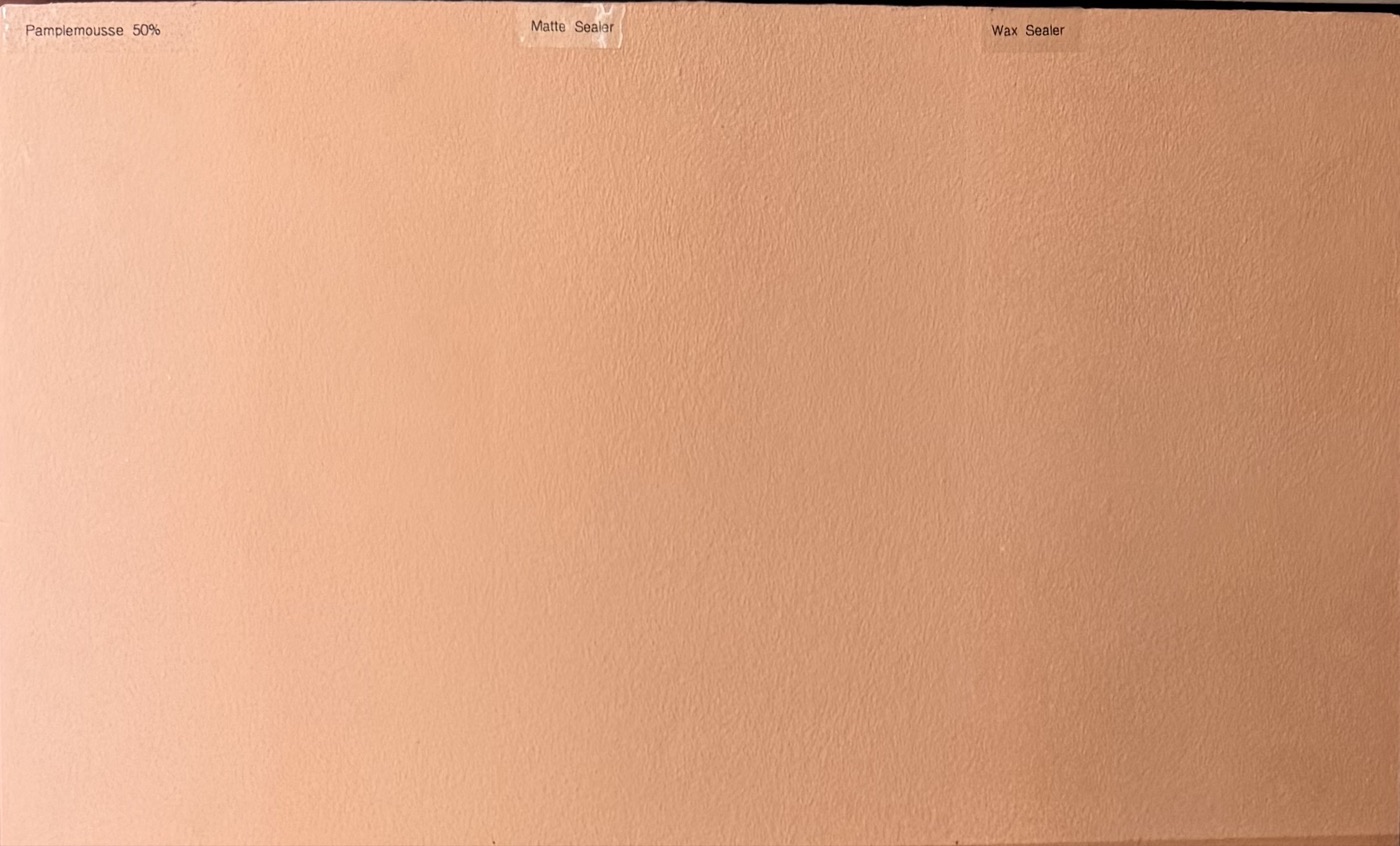
One color, three finishes — bare · matte sealer · wax
Can limewash be subtle, or is it always dramatic?
Either. The finish is shaped by how it is applied — tool, number of coats, and how far we push the contrast between light and shade. Tone-on-tone gives a quiet, architectural surface; more contrast gives movement you notice across the room. We settle on it with you at sampling.
How long does it last?
It doesn’t peel or blister like conventional paint, because it is bonded into the surface rather than sitting on top. Properly applied, it ages gracefully — many find it improves as it settles.
Is it safe for children and pets?
Yes. Zero-VOC, non-toxic, and mineral rather than synthetic. The high alkalinity also makes it naturally antimicrobial — one reason clients choose it for bedrooms and nurseries.
How long does a room take?
It depends on the size and condition of the room. Every project is two hand-applied coats with proper drying time between, and we’ll give you a timeline for your specific space at consultation.
Can I see the color before committing?
Yes — we talk through color as part of your consultation, and painted samples directly on your walls are available as an add-on, so you can live with the color in your own light before deciding. Limewash shifts noticeably between daylight and lamplight, so seeing it in the room matters more than with ordinary paint.
What is the Charter Client Program?
A one-time founding program. We’re choosing fifteen New York City spaces — homes, rentals and storefronts across Manhattan, Brooklyn and Queens — and offering our hand-applied limewash at 30% off our standard rate. In exchange, we photograph the space before, during and after for our portfolio, and ask you for a few honest words about how it went — yours, whatever they turn out to be. Every project is still quoted after we’ve seen and measured the walls; the Charter simply applies the founding rate to it. Spots must be approved and booked by November 30, 2026, and once the fifteen are painted the rate closes for good. Read more and apply →